
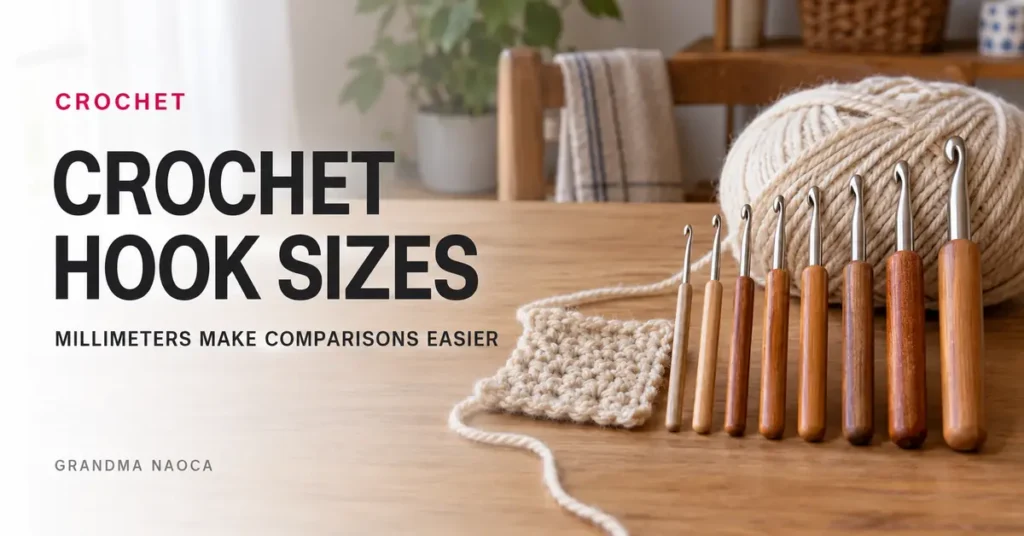
Hook labels can include millimeters, letters, numbers, or a combination of all three. That looks confusing until you separate the actual size from the naming system. The millimeter measurement is the best place to start.
| Millimeters | Common label |
|---|---|
| 3.5 mm | E/4 |
| 3.75 mm | F/5 |
| 4 mm | G/6 |
| 4.25 mm | G |
| 5 mm | H/8 |
| 5.5 mm | I/9 |
| 6 mm | J/10 |
These examples come from the Craft Yarn Council’s sizing reference. The two G entries are a useful reminder to read the millimeters instead of assuming a letter gives one exact size.
Choose a starting size, then check the result
A pattern normally suggests a hook and gives a gauge. The hook is a starting point; the gauge tells you whether your stitches make the intended dimensions. Yarn labels also offer general guidance, but a project can intentionally use a different size for a particular fabric.
If your sample has more stitches across the measurement area than required, your stitches are smaller. Try a larger hook and measure again. If it has fewer stitches, try a smaller hook. Evaluate the feel of the fabric as well as the count.
Steel thread hooks are a separate case
Fine steel hooks often use numbers in which a larger number identifies a smaller hook. Their millimeter equivalents and labels can differ between manufacturers. For thread crochet, match the pattern and check the specific manufacturer’s measurement rather than using a regular-hook letter chart.
Identify a hook with a worn label
A crochet hook gauge can help if its slots are designed for hook shafts. Measure the working shaft, not the pointed end, curved head, or tapered throat. Some handle shapes make this awkward; the manufacturer’s original listing or packaging may be a better reference.
Once you identify a size, add a removable tag to the case or take a photo of the hook beside its label. Avoid treating a rough visual guess as a reliable measurement for a fitted project.
Keep the size with your project notes
Write both the millimeter measurement and the brand or model. If you put a project aside, this helps you return to the same tool. A change in hook shape or grip can alter tension even when the size marking is identical.
Your practical checklist
- Find the millimeter size first.
- Check whether the hook is a regular yarn hook or a steel thread hook.
- Read the pattern’s gauge requirement.
- Adjust size with a measured swatch.
- Record the exact tool with the yarn and project.
Frequently asked questions
Is every G hook 4 mm?
No. G labels can include different measurements. Read the size printed in millimeters.
Does a bigger hook always make a bigger item?
With the same yarn and stitch it usually makes larger loops, but gauge, stitch choice, and construction all affect the result.
Can I use the knitting needle conversion for crochet?
Use the crochet hook reference. Knitting and crochet size recommendations are not interchangeable.
Keep learning
- How to Choose a Crochet Hook That Fits Your Project
- How to Make and Measure a Crochet Gauge Swatch
- How to Choose Yarn for Crochet: Fiber, Weight, and Feel
Helpful references: Craft Yarn Council hook sizing reference. These resources support terminology and general guidance; your pattern instructions and yarn care label take priority.