
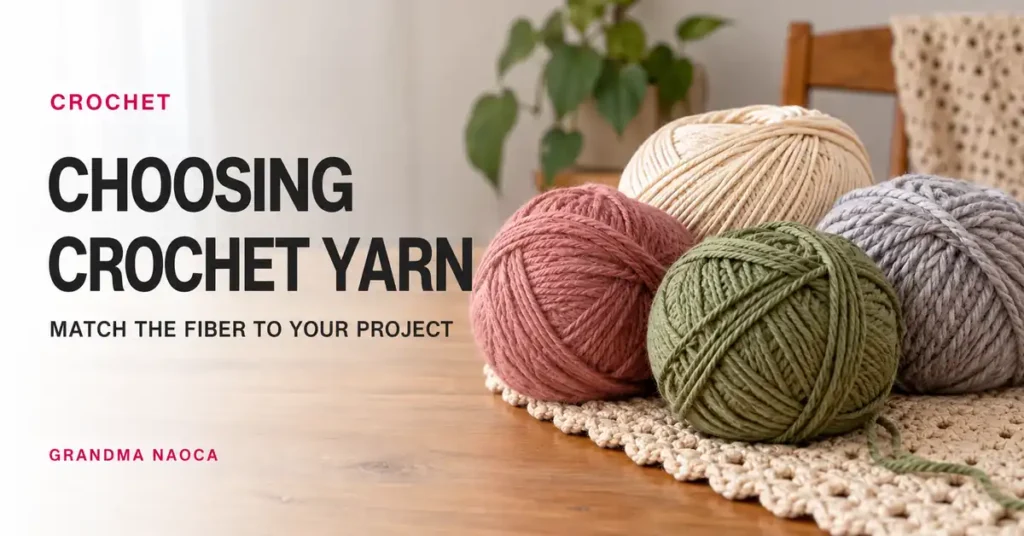
Two balls of yarn can look almost alike and behave very differently. One may make a crisp little basket; the other may make a soft scarf. Reading the label helps you choose a yarn for the finished piece rather than for its color alone.
| Fiber or yarn type | Consider before choosing |
|---|---|
| Cotton | Often gives defined stitches and less stretch; drape and softness vary. |
| Acrylic | Often light and available in many colors; follow its heat and washing instructions. |
| Wool | Can be warm and springy; some wool needs careful hand washing. |
| Blends | Read the percentages and care label rather than assuming one fiber dominates. |
| T-shirt yarn or cord | Can make bulky, structured pieces; width and weight may vary. |
Learn what the yarn weight means
The U.S. system runs from category 0, lace, through category 7, jumbo. A category 4 medium yarn is not the same thickness as category 2 fine yarn, even when both are cotton. The category helps narrow your search; it does not replace a gauge swatch.
Read the crochet hook recommendation separately from the knitting needle recommendation. They are often shown together on the same band, and their suggested sizes may differ.
Compare yardage as well as the price
A ball weighing 100 grams does not necessarily contain the same length as another 100-gram ball. Different fibers and constructions have different densities. Compare yards or meters and the amount your pattern requires. If comparing thickness by length per weight, do so cautiously between otherwise similar yarns.
For a multiball project, check the color name and dye lot. Small differences between batches may show once you join the yarn. Buy the pattern’s required amount with a sensible allowance rather than assuming every ball is interchangeable.
Match the yarn to everyday use
Ask whether the piece needs softness, structure, stretch, warmth, or frequent washing. A decorative basket and a wearable scarf have different jobs. An attractive substitution can still change the finished size, drape, or care routine.
Check the care label before buying. “Wool” does not automatically mean hand-wash-only, and “acrylic” does not automatically mean every drying method is safe. The product’s instructions are more useful than broad assumptions.
Make a small sample before buying more
Crochet enough to see the stitches and feel the fabric. Let the sample rest, then wash and dry it as you intend to care for the finished piece. Check whether its size, color, or texture changes. Keep that sample and the label with your project notes.
Your practical checklist
- Read fiber percentages and weight category.
- Check crochet hook guidance, not the knitting column.
- Compare yardage and required project quantity.
- Match dye lots for a consistent color.
- Test the fabric and its care routine on a swatch.
Frequently asked questions
Can I substitute any category 4 yarn?
Not automatically. Similar weight categories can still have different fibers, drape, yardage, and gauge.
Is expensive yarn always easier to use?
No. Smooth yarn with clear stitches and suitable care instructions can be a better beginner choice.
Should I throw away the paper band?
Keep it or photograph it. Fiber, care details, color, dye lot, and yardage are useful later.
Keep learning
- Crochet for Beginners: What You Actually Need to Buy
- How to Make and Measure a Crochet Gauge Swatch
- How to Wash and Store Crochet So It Keeps Its Shape
Helpful references: Craft Yarn Council yarn weight system. These resources support terminology and general guidance; your pattern instructions and yarn care label take priority.