
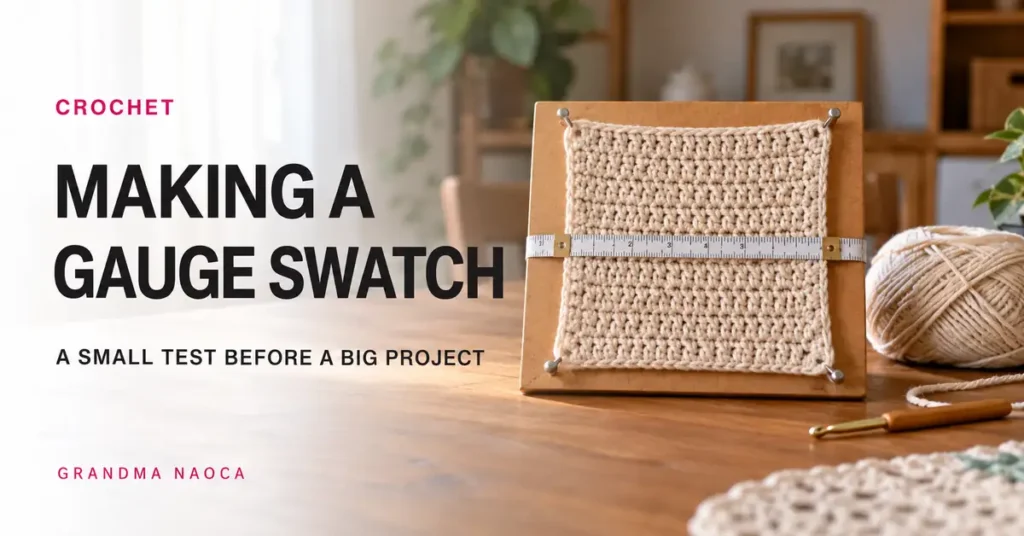
A gauge swatch is a small test that can prevent a much larger sizing problem. It shows how your yarn, hook, stitch pattern, and hands work together. For a fitted piece, those measurements matter more than the hook size printed at the top of the pattern.
Give the measuring area room
If a pattern specifies gauge over 4 inches, make a swatch larger than 4 inches so you can measure away from the edges. Around 6 inches can be a practical starting size, but bulky stitches or long repeats may require more.
Use the actual yarn and hook you intend to use. A single crochet sample cannot reliably predict the gauge of a textured stitch pattern. If the project is worked in the round, check whether the designer requires an in-the-round swatch.
Measure the center without pulling
Lay the sample flat on a stable surface. Place a ruler across the middle and count stitches within the specified distance, including partial stitches when necessary. Measure rows vertically in another central area. Repeat the measurement to see whether the sample is consistent.
Follow the pattern’s stated unit. Four inches is 10.16 centimeters, not exactly 10 centimeters. A pattern may round those units; use one stated measurement consistently instead of switching between them during a close sizing check.
| Your count across the required distance | Likely next test |
|---|---|
| More stitches than the pattern | Try a larger hook to make larger stitches. |
| Fewer stitches than the pattern | Try a smaller hook to make smaller stitches. |
| Stitch gauge matches but row gauge differs | Check technique and the pattern’s construction guidance before changing tools. |
Use a concrete comparison
Suppose the pattern asks for 18 stitches across 4 inches and your sample has 20. Your stitches are smaller, so the finished item may come out too small if you keep the same stitch count. Try a larger hook, make another sample, and measure again.
Do not stretch a sample until it matches the desired number. Gauge should describe the fabric under the conditions the finished piece will actually experience. Check that any adjustment still produces a suitable texture and drape.
Check the fabric after care
Some yarns relax or change dimensions after washing. Care for the swatch according to the yarn label and the pattern, let it dry completely, then measure again. Record both measurements if that helps you understand the change.
Keep the swatch with the yarn band and your hook notes. It is a reference for the project and a safe place to test finishing or care methods.
Your practical checklist
- Read the exact gauge, units, and stitch pattern.
- Make a sample larger than the measurement area.
- Count stitches and rows in the center.
- Wash and dry as the label and pattern direct.
- Adjust the hook and repeat if needed.
Frequently asked questions
Do all crochet projects need exact gauge?
A fitted item usually does. A practice square may not, though gauge can still affect size and yarn use.
What if stitch gauge matches but row gauge does not?
Read the pattern’s shaping and construction notes. Some designs allow row adjustments; others require a closer match. Do not change counts blindly.
Can I measure while the sample is wet?
Use the conditions specified by the pattern, usually after it has dried and settled. A wet, stretched piece is not a dependable everyday-size reference.
Keep learning
- How to Choose a Crochet Hook That Fits Your Project
- How to Keep Your Crochet Tension More Even
- How to Block Crochet Without Damaging the Yarn
Helpful references: Craft Yarn Council hook and gauge guidance, Craft Yarn Council yarn weight guidelines. These resources support terminology and general guidance; your pattern instructions and yarn care label take priority.