
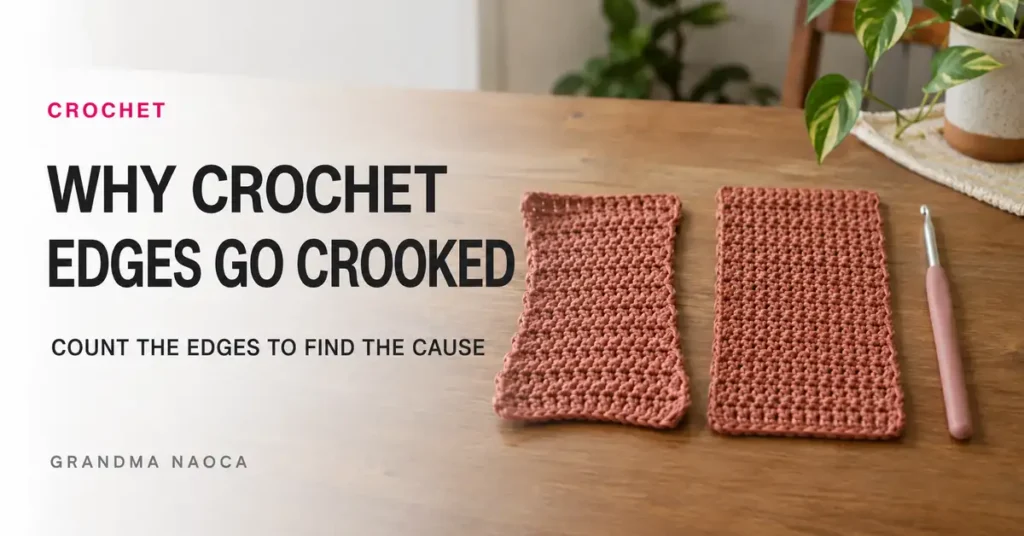
A practice rectangle that turns into a triangle can be discouraging. Before adding a border or trying to stretch it straight, look at the first and last stitches of each row. The edges often reveal exactly where the problem began.
| What you see | What to check |
|---|---|
| The piece gets narrower | A skipped first or last stitch. |
| The piece gets wider | An extra edge stitch or a turning chain counted twice. |
| The count stays right but width changes | Tension, yarn feed, or an accidental hook change. |
| One edge has repeated gaps | Where the first stitch is placed and how the turning chain is treated. |
Make the turning-chain rule explicit
Read whether the pattern counts the turning chain as a stitch. If it does, placing another stitch into the same edge position may add an unintended stitch. If it does not, skipping the first real stitch may remove one.
For a beginner single crochet strip, you can use a chain 1 that does not count, then work every real stitch once. That is an exercise rule, not a universal instruction for every crochet pattern.
Mark the two edges
Put a locking marker into the first completed stitch and another into the last. Move them as you finish each new row. The markers help you find the final stitch when it curls or looks smaller than the others.
Count at the end of every row while learning. A quick count is less work than discovering five rows later that the shape has changed. Keep the active loop on the hook separate from your stitch count.
Find the first incorrect row
Lay the fabric flat and compare its width and stitch counts from the bottom upward. If a stitch was added or lost, unravel to that row and work it again. Adding random increases later may restore the total but still leave a visible change in the edges.
If all counts are correct, compare the hook size and loop sizes. A starting chain that is much tighter than the later rows can also pull the base inward. Try a new small sample to see whether a looser chain solves that specific issue.
Know what finishing can and cannot fix
Blocking may even out a suitable piece after its construction is correct. A border can give a deliberate finish. Neither is a reliable substitute for missing stitches, unwanted increases, or an incorrect repeat. Fix the structure first, then choose the finish.
Your practical checklist
- Count the stitches in the first uneven row.
- Check the turning-chain rule.
- Mark and work both edge stitches.
- Unravel to the first structural mistake if needed.
- Check tension only after the counts are right.
Frequently asked questions
Can I fix narrowing by adding a stitch next row?
That may change the count but does not remove the earlier missing stitch. Reworking the first incorrect row usually gives a cleaner rectangle.
Should I always crochet into the turning chain?
Only when the pattern’s instructions require it. Turning-chain rules differ.
Can blocking straighten any crooked piece?
No. Blocking can refine shape, but it does not repair missing or extra stitches.
Keep learning
- How to Count Crochet Stitches, Rows, and Rounds
- How to Keep Your Crochet Tension More Even
- How to Block Crochet Without Damaging the Yarn
Helpful references: Craft Yarn Council crochet terms. These resources support terminology and general guidance; your pattern instructions and yarn care label take priority.