
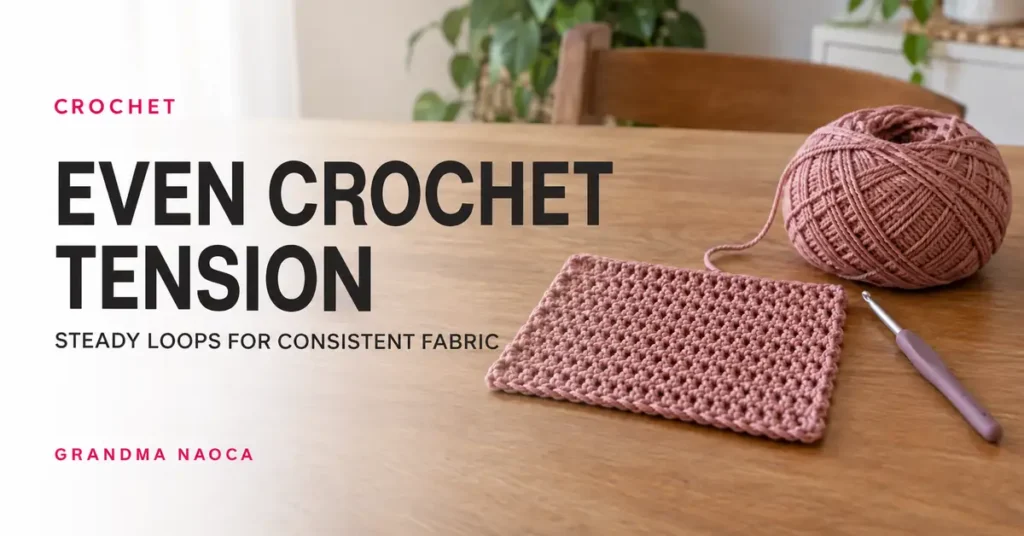
An even piece of crochet comes from repeatable loops, not from holding everything as tightly as possible. If one row looks firm and the next looks loose, slow down and notice how the yarn and hook move through your hands.
Let the shaft set the loop size
The throat near the hook head may be narrower than the working shaft. If you tighten every loop there, the stitches can become small and hard to enter. Let the loop sit on the shaft before drawing through, without stretching it far up the handle.
Pause after a few stitches and look at the loop sizes. A rushed pull can change tension even when the yarn is held the same way. Aim for a motion you can repeat rather than copying another person’s exact hand position.
Find a yarn path that feels natural
Some crocheters guide yarn over one finger; others use a different route through the hand. Try a short sample with each comfortable option. The yarn should move with gentle resistance, without cutting into your skin or constantly slipping away.
Also check the ball or skein. A tangled center pull or yarn caught under a bag can create sudden resistance that looks like a hand-tension problem. Give the yarn enough room to feed freely.
Use a sample to find where things change
Make several rows with the same yarn, stitch, and hook. Mark the edges and count each row so a missed stitch does not masquerade as a tension issue. Lay the fabric flat without pulling it and compare the middle of the rows.
Notice whether your stitches change when you speed up, resume after a break, or change grip. A short pause to settle into the movement can help you return to a project more consistently.
Adjust the hook after your movement settles
If the fabric stays too tight even with comfortable movement, try a slightly larger hook. If it stays too loose, try a smaller one. For a sized project, measure the pattern’s gauge before deciding.
Do not pull completed rows aggressively to force them into shape. Blocking can settle suitable fabric, but it cannot turn inconsistent stitch counts into correct ones. Take breaks and avoid working through discomfort.
Keep a simple project record
Save the hook size, yarn label, and a sample. These small notes are useful when a piece rests for several days. You can compare the next row with the sample instead of guessing how tightly you held the yarn last time.
Your practical checklist
- Check that the yarn feeds freely.
- Form loops on the working shaft.
- Practice a steady, comfortable motion.
- Count the stitches before blaming tension.
- Use measured gauge to choose any hook adjustment.
Frequently asked questions
Does good tension mean tight stitches?
No. Good tension means a suitable, repeatable fabric. Very tight stitches can be hard to work and may not match the pattern.
Can changing hook size help?
Yes, once your movement is reasonably consistent. Measure a new swatch rather than assuming the change will be enough.
Why does tension change after a break?
Grip, pace, and yarn feed can change. Work a few deliberate stitches and compare them with your earlier fabric.
Keep learning
- How to Make and Measure a Crochet Gauge Swatch
- Why Your Crochet Edges Go Crooked—and How to Find the Cause
- 7 Crochet Basics to Practice Before Your First Project
Helpful references: Craft Yarn Council hook and gauge guidance. These resources support terminology and general guidance; your pattern instructions and yarn care label take priority.