
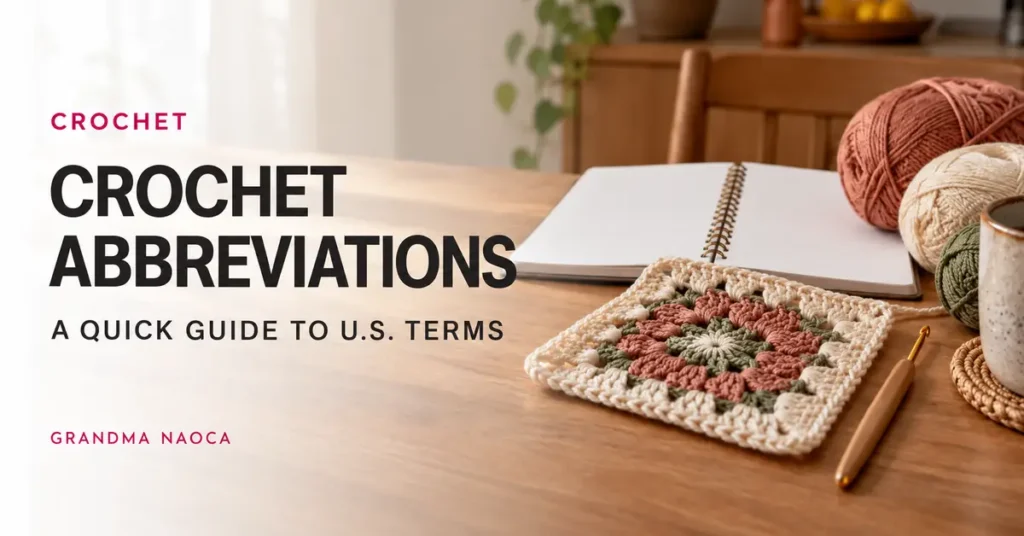
Short crochet instructions become easier to read once you recognize a few common abbreviations. Keep this guide beside your pattern, but check its special-stitch notes first. A familiar abbreviation can still have a designer-specific instruction attached to it.
| Abbreviation | Meaning |
|---|---|
| ch | chain |
| sl st | slip stitch |
| sc | single crochet |
| hdc | half double crochet |
| dc | double crochet |
| tr | treble crochet |
| yo | yarn over |
| st / sts | stitch / stitches |
| rnd | round |
| rep | repeat |
| inc | increase |
| dec | decrease |
| BLO / FLO | back loop only / front loop only |
| RS / WS | right side / wrong side |
| sc2tog | single crochet two stitches together |
Read the whole instruction before working
“2 sc in next st” means work two single crochet stitches into the next stitch. It is an increase. “Sc in next 2 sts” means one single crochet in each of the next two stitches. The same numbers produce different results depending on their position.
An instruction such as “sc2tog” combines two stitches into one. An increase or decrease changes the total; use the count supplied at the end of the row or round to check your work.
Understand repeat marks
Asterisks, brackets, and parentheses can show repeated groups, stitches worked into the same location, or a final count. Their exact use varies by pattern. Read the designer’s explanation instead of assuming every bracket means the same thing.
As a practice example, repeating “sc in next 2 sts, 2 sc in next st” consumes three base stitches and produces four single crochet stitches. Check how many repeats the pattern requires and whether there are edge stitches outside the repeated group.
| U.S. term | U.K. term |
|---|---|
| single crochet (sc) | double crochet (dc) |
| half double crochet (hdc) | half treble crochet (htr) |
| double crochet (dc) | treble crochet (tr) |
| treble crochet (tr) | double treble crochet (dtr) |
Check special stitches and the turning chain
Clusters, shells, bobbles, and invisible decreases can be worked in different ways. The pattern should explain its version. A general glossary tells you what a label usually means; it does not replace that instruction.
Also note whether the turning chain counts as a stitch, how rounds are joined, and which loop or space receives the next stitch. These small notes can decide whether the total stays correct.
Your practical checklist
- Confirm that the pattern uses U.S. terminology.
- Read the special-stitch notes.
- Distinguish stitches in one location from stitches across several locations.
- Identify repeats and any edge stitches outside them.
- Compare your completed count with the stated total.
Frequently asked questions
Can I read a U.K. pattern with this glossary?
Use a U.S.–U.K. conversion reference first. Identical-looking abbreviations may name different stitches.
Does inc always mean two single crochet stitches?
No. The stitch type and increase method depend on the pattern. Read its definition.
What if an abbreviation is missing here?
Check the pattern’s glossary and the Craft Yarn Council reference. Do not guess an unfamiliar special stitch.
Keep learning
- 7 Crochet Basics to Practice Before Your First Project
- How to Read a Crochet Chart Without Losing Your Place
- How to Count Crochet Stitches, Rows, and Rounds
Helpful references: Craft Yarn Council abbreviations and U.S.–U.K. comparison. These resources support terminology and general guidance; your pattern instructions and yarn care label take priority.