
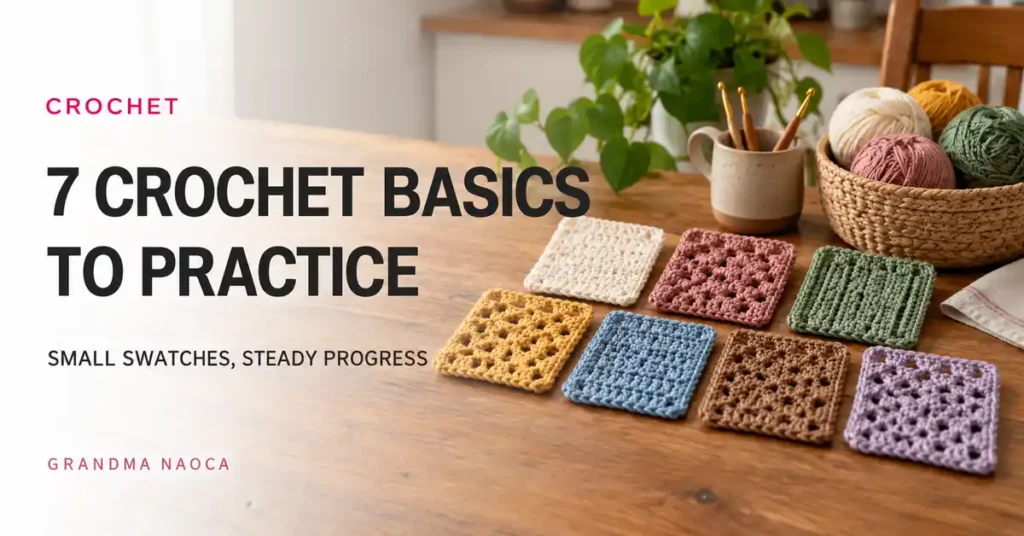
You do not need to memorize a whole stitch dictionary before making something useful. A few small samples can teach you how loops, stitch height, and shaping work. Practice these seven basics slowly and keep the samples so you can compare them.
The seven basics
1. Chain (ch)
With one loop on the hook, yarn over and pull the yarn through that loop. Repeat for a chain. Make the loops even rather than pulling them as tight as possible; a tight starting chain can make the first row difficult.
2. Slip stitch (sl st)
Insert the hook into the indicated stitch, yarn over, and pull through both the stitch and the loop on your hook. Slip stitches are short and are often used to join work. A joining slip stitch does not automatically count as a new stitch in the round.
3. Single crochet (sc)
Insert the hook into the stitch, yarn over, and pull up a loop. There are now two loops on the hook. Yarn over and pull through both loops. Look for the V at the top of the finished stitch.
4. Half double crochet (hdc)
Yarn over before inserting the hook. Insert it, yarn over, and pull up a loop: three loops are on the hook. Yarn over and pull through all three. This produces a taller stitch than single crochet.
5. Double crochet (dc)
Yarn over, insert the hook, yarn over, and pull up a loop. Yarn over and pull through two loops; yarn over again and pull through the last two. Double crochet is taller and can create a more open fabric.
6. Increase (inc)
For a simple single crochet increase, work two single crochet stitches into one stitch. One increase adds one stitch to the row or round. Patterns may use other increase methods, so read their special instructions.
7. Decrease (dec)
For a basic single crochet two together (sc2tog), insert the hook into the next stitch and pull up a loop, then repeat in the following stitch. Yarn over and pull through all three loops. Two stitches become one. Invisible decreases are a different technique; use whichever the pattern specifies.
Practice one skill at a time
Start with the 20-stitch single crochet strip described in our beginner kit guide. Work half double crochet and double crochet in separate samples so you can see their different heights. Use the turning chain rule chosen for each exercise or pattern consistently.
For a shaping exercise, begin with a 20-stitch single crochet row. Put one increase in the next row and count 21 stitches. Put one decrease in the following row, working the other stitches once, and count 20. This is practice, not a finished-item pattern.
Your practical checklist
- Use smooth yarn and a matching hook.
- Work a small sample of each basic stitch.
- Mark the first and last stitches.
- Count before and after each increase or decrease.
- Label samples with the U.S. stitch name and hook size.
Frequently asked questions
Are U.S. and U.K. double crochet the same?
No. U.K. double crochet corresponds to U.S. single crochet. Check the terminology before following a pattern.
Should the turning chain count as a stitch?
That depends on the pattern or exercise. There is no single rule for every stitch and designer.
Why do my first chains look uneven?
Your hand is learning a new motion. Make a short chain slowly and let the hook shaft set the loop size without squeezing it tight.
Keep learning
- Crochet for Beginners: What You Actually Need to Buy
- How to Keep Your Crochet Tension More Even
- Crochet Abbreviations: A Quick Guide to U.S. Terms
Helpful references: Craft Yarn Council U.S. crochet abbreviations. These resources support terminology and general guidance; your pattern instructions and yarn care label take priority.