
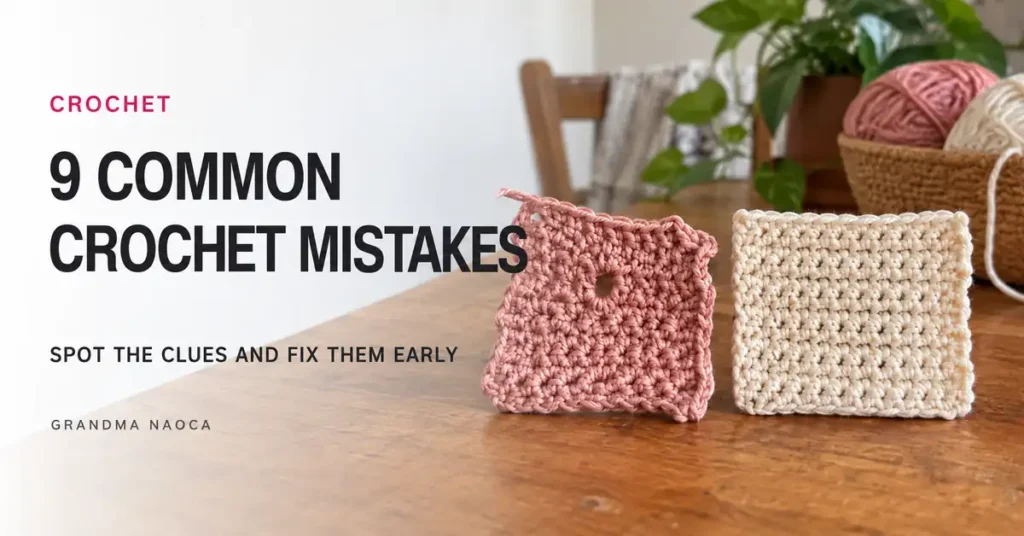
Crochet mistakes usually leave clues: a changing stitch count, a rippled edge, or fabric that feels different halfway through. Finding the cause is more useful than trying to hide the result. These nine checks can help you catch problems while they are still small.
Nine things to check
1. Working into the wrong space
A gap between stitches is not always the next stitch. Find the top V and read whether the pattern wants a stitch, chain space, or special location. Practice on a smooth yarn if the tops are hard to see.
2. Missing the edge stitches
The first or last stitch can curl and disappear visually. Mark both edges and count at the end of each row. A narrowing rectangle often begins with one skipped edge.
3. Changing the turning-chain rule
Check whether the chain counts as a stitch and where the first stitch belongs. Treating it differently in alternate rows can add or remove stitches.
4. Pulling loops unevenly
Let loops sit on the hook’s working shaft and use a comfortable pace. Also check whether the yarn ball is catching. Count first so you can separate tension changes from missing stitches.
5. Using an unsuitable hook size
Read the millimeters, make a swatch, and check the intended fabric. A stiff scarf or overly open basket may need a different hook or yarn rather than tighter hands.
6. Substituting yarn without checking
Compare fiber, weight category, yardage, care, and gauge. A similar color or ball size does not make two yarns equivalent.
7. Skipping the pattern key
Read special stitches, chart symbols, repeats, and U.S. versus U.K. terminology before beginning. Guessing an unfamiliar abbreviation can change the whole stitch pattern.
8. Cutting tails too short
Leave enough yarn for a secure finishing route. A tiny tail beside a knot is harder to hide and may loosen during use or washing.
9. Putting the work away without notes
Record the last completed row or round, stitch total, hook size, and changes. A marker and one clear sentence can make restarting much easier.
Decide whether the mistake needs reworking
A missed shaping stitch, wrong count, or incorrect repeat can affect fit and structure. Find the first incorrect row and rework it when necessary. Adding compensating stitches later may preserve a total while leaving the shape wrong.
A tiny cosmetic irregularity in a practice piece is a different decision. You can keep it as a learning sample if it does not undermine the intended project. Avoid treating every imperfection as a failure—or every structural error as something blocking will fix.
Your practical checklist
- Compare the actual count with the pattern.
- Check edge placement and turning chains.
- Confirm yarn, hook, terminology, and repeats.
- Locate the first incorrect section.
- Rework structural errors and record the fix.
Frequently asked questions
Should I unravel every little flaw?
Not necessarily in a practice piece. Consider whether it affects fit, function, or structure. A wrong shaping count usually matters more than a small visual variation.
Can a border hide all edge problems?
No. A border can finish correct fabric, but missed stitches or unwanted increases should be addressed first.
How can I learn to recognize errors?
Use a small sample and deliberately compare a correct row with a row containing one missed or added stitch. Keep the sample as a reference.
Keep learning
- Why Your Crochet Edges Go Crooked—and How to Find the Cause
- Crochet Abbreviations: A Quick Guide to U.S. Terms
- How to Finish Crochet Neatly: Ends, Seams, and Edges
Helpful references: Craft Yarn Council crochet terminology, Craft Yarn Council hook guidance. These resources support terminology and general guidance; your pattern instructions and yarn care label take priority.