

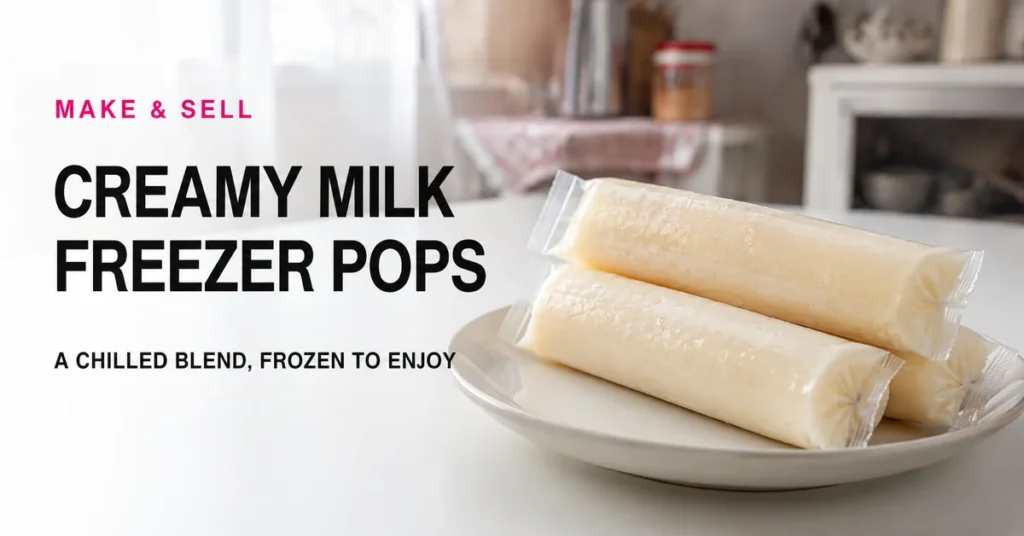
Brazilian geladinhos are frozen treats portioned into small food-safe pouches. This milk-powder version blends into a smooth base with very little foam. Equal portions make the freezing process and finished size more predictable.
- Prep
- 15 minutes
- Cook or chill
- freeze until fully solid; time depends on pouch size and freezer
- Yield
- about 12 pouches at 120 ml (4 fl oz), with possible extra base
Ingredients
The original recipe uses a 240 ml cup and 15 ml tablespoon. U.S. volumes, pan sizes, and oven settings are rounded; listed grams and milliliters are the best guide for repeating a batch. Use Brazilian table cream and 50% cocoa chocolate powder where specified, rather than assuming U.S. heavy cream or unsweetened cocoa is identical.
Milk mixture
- 1 liter chilled pasteurized whole milk
- 395 g sweetened condensed milk
- 200 g Brazilian table cream
- 1 cup whole milk powder, measured in a 240 ml cup
- Neutral frozen-dessert stabilizer at its labeled dose, optional
- 1 teaspoon vanilla extract, optional
Packaging
- Clean food-safe freezer-pop pouches with room for expansion
How to make it
- Clean your funnel, pitcher, counter, and hands. Use food-safe pouches designed for freezing and a freezer at 0°F (-18°C) or below.
- Mix the milk powder with the optional stabilizer, using only the manufacturer’s dose for this amount of mixture.
- Blend the cold milk, condensed milk, cream, dry ingredients, and optional vanilla for about 1 minute, just until smooth.
- Let foam settle for 10 minutes in the refrigerator, or skim with a clean spoon.
- Funnel about 120 ml into each pouch. Leave enough empty space for expansion and use the pouch’s recommended secure closure.
- Lay the pouches separately in a single layer until fully frozen. Group them in covered containers once solid.
- Keep frozen until serving, and transport with equipment that maintains frozen conditions. Measure the actual finished volume; it may fill more than 12 pouches.
Small details that help
Milk fat, sugar, and milk solids all affect the frozen texture. Changing just one ingredient can make the pops icier or softer. A crowded freezer slows freezing, so begin with a single layer and avoid frequent door opening.
Portioning and packaging
Record base volume, portion weight, foam losses, and the actual pouch count. Packaging, freezer electricity, insulated transport, and delivery time are real costs. A home freezer and a popular flavor do not establish permission to sell dairy frozen desserts.
Thinking of selling this in the U.S.?
Check this exact product with your state and local food regulator before taking orders. Home-food permissions depend on the location, recipe, kitchen, and sales channel. Refrigerated dairy, custard, chicken, and meat products must not be assumed eligible for cottage-food sales. Ask about permits, approved facilities, handling, labeling, and delivery restrictions. The FDA food-business overview is a starting point, not approval to sell this recipe.
Calculate costs from your own batch
- Record ingredient quantities and current local costs in U.S. dollars.
- Add packaging, labels, utilities, refrigeration or freezing, waste, and labor.
- Divide the batch cost by the actual number of acceptable finished units.
- Include applicable taxes, overhead, delivery, and payment fees when setting a price.
No selling price, profit margin, sales volume, or income is guaranteed. A trial batch helps you assess consistency; it does not validate commercial food safety.
Labels and allergens
Check ingredient and packaging labels for milk, eggs, wheat, soy, nuts, and other allergens that apply to this batch. Keep supplier information and ingredient subcomponents, and prevent cross-contact. A short list of likely allergens is not a complete sales label. Ask the regulator what ingredient order, net quantity, business identification, allergen statements, and any cottage-food notice are required. See the FDA food-allergen guidance.
Storage and delivery
Frequently asked questions
Do I have to use stabilizer?
No. It is optional in the original recipe. If used, follow its food-use label rather than guessing a teaspoon amount.
Why does the yield exceed 12?
The full formula can produce extra base. Twelve 120 ml pouches are a planning estimate, not a precise volume calculation.
Can I freeze thawed pops again?
Avoid thaw-and-refreeze cycles. If temperature control is lost, freezing again does not make an unsafe mixture safe.