

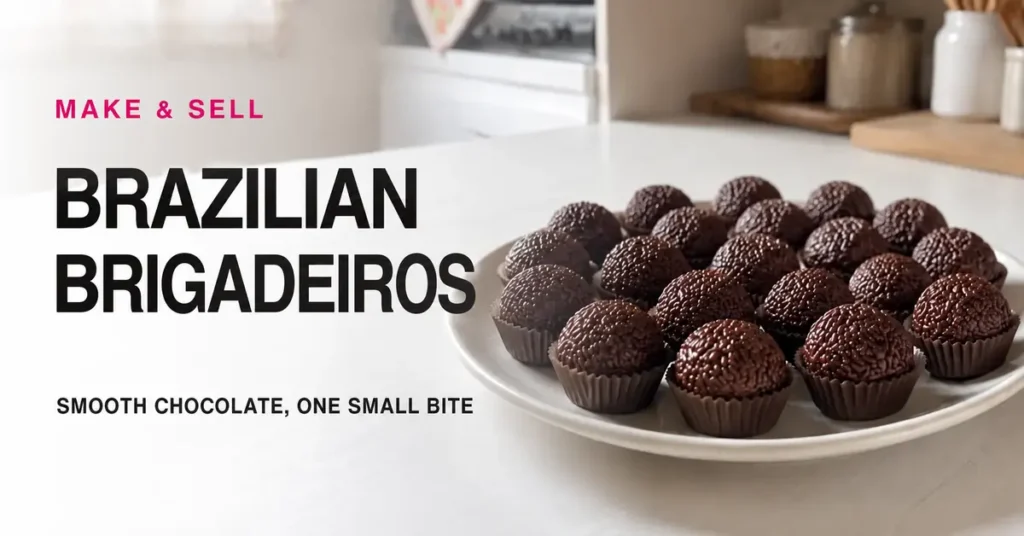
These soft chocolate sweets begin with condensed milk and finish with a coating of sprinkles. The original family-style recipe watches for the path a spatula leaves in the pan. That visual cue matters more than a fixed number of minutes, especially when the pan or stove changes.
- Prep
- 10 minutes
- Cook or chill
- about 20 minutes cooking, plus cooling and 1 hour chilling
- Yield
- about 24 sweets; start with 18 g filling per sweet
Ingredients
The original recipe uses a 240 ml cup and 15 ml tablespoon. U.S. volumes, pan sizes, and oven settings are rounded; listed grams and milliliters are the best guide for repeating a batch. Use Brazilian table cream and 50% cocoa chocolate powder where specified, rather than assuming U.S. heavy cream or unsweetened cocoa is identical.
Brigadeiro mixture
- 395 g sweetened condensed milk (about one 14 oz can)
- 200 g Brazilian table cream
- 80 g milk or semisweet chocolate
- 20 g Brazilian 50% cocoa chocolate powder
- 10 g unsalted butter
Finishing
- 150 g chocolate sprinkles
- A little butter for your hands
- 24 small candy cups
How to make it
- In a heavy saucepan, combine the condensed milk, cream, and chocolate powder before turning on the heat.
- Add the chopped chocolate and butter. Cook over low heat, stirring continuously across the bottom and sides.
- When the mixture becomes thick, draw a spatula through it. The path should remain visible for a few seconds, and the mixture should fall in a soft mass rather than a thin ribbon.
- Transfer to a clean shallow dish, cover the surface, and cool promptly under refrigeration. Chill for at least 1 hour, until easy to handle.
- With clean, lightly buttered hands, weigh portions of about 18 g and roll gently. Coat with sprinkles.
- Set in candy cups, place in a covered food-safe container, and refrigerate. The actual count depends on evaporation and the portion size.
Small details that help
Use the same pan and heat setting to make batches comparable. A thermometer can help record a successful batch, but there is no universal finishing temperature for every chocolate and altitude. A flat sweet may need more cooking or more chilling; a gritty mixture can reflect crystallization or excessive heat.
Portioning and packaging
Record the finished mixture weight before rolling, plus the sprinkles actually used. Each new flavor needs its own formula, cost sheet, storage plan, and trial batch. Changing to white chocolate or adding nuts is more than a decorative change.
Thinking of selling this in the U.S.?
Check this exact product with your state and local food regulator before taking orders. Home-food permissions depend on the location, recipe, kitchen, and sales channel. Refrigerated dairy, custard, chicken, and meat products must not be assumed eligible for cottage-food sales. Ask about permits, approved facilities, handling, labeling, and delivery restrictions. The FDA food-business overview is a starting point, not approval to sell this recipe.
Calculate costs from your own batch
- Record ingredient quantities and current local costs in U.S. dollars.
- Add packaging, labels, utilities, refrigeration or freezing, waste, and labor.
- Divide the batch cost by the actual number of acceptable finished units.
- Include applicable taxes, overhead, delivery, and payment fees when setting a price.
No selling price, profit margin, sales volume, or income is guaranteed. A trial batch helps you assess consistency; it does not validate commercial food safety.
Labels and allergens
Check ingredient and packaging labels for milk, eggs, wheat, soy, nuts, and other allergens that apply to this batch. Keep supplier information and ingredient subcomponents, and prevent cross-contact. A short list of likely allergens is not a complete sales label. Ask the regulator what ingredient order, net quantity, business identification, allergen statements, and any cottage-food notice are required. See the FDA food-allergen guidance.
Storage and delivery
Frequently asked questions
Is compound coating the same as chocolate?
No. It uses different fats and behaves differently. Use the specified chocolate in the filling and follow the label for any coating.
Can I omit the cream?
That makes a different formula with a different texture and yield. Start with a small test rather than keeping the same assumptions.
What size should I make?
Pick a portion that fits your packaging, weigh each sweet, and state the required quantity or net weight on the sales label.