

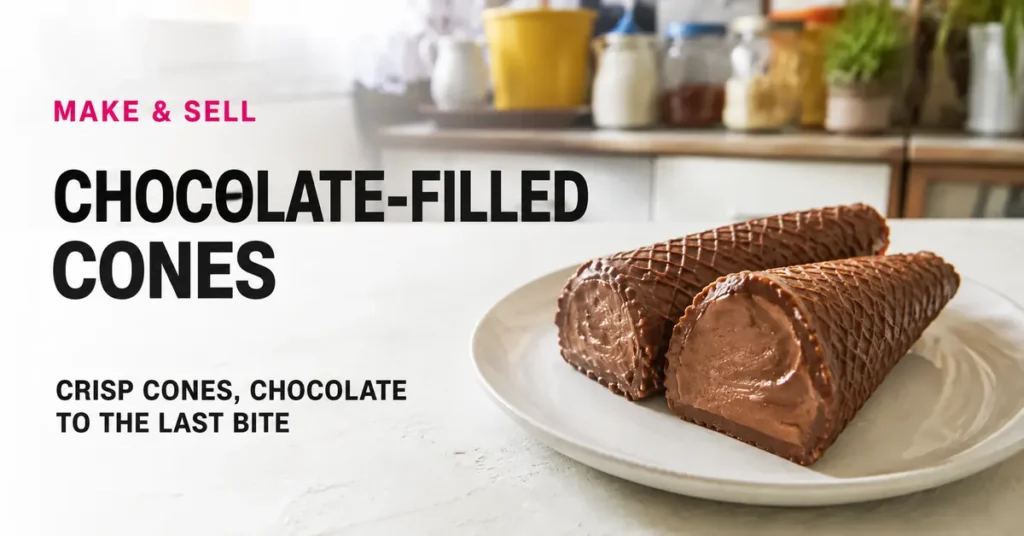
These cones hide a creamy chocolate center inside a crisp cookie shell. The original recipe borrows a simple pantry lesson: keep crisp foods away from moisture. A thin chocolate lining reaches the cone’s tip and rim, helping protect it from the filling.
- Prep
- 25 minutes
- Cook or chill
- filling cooking, cooling, and chocolate setting time vary
- Yield
- 12 cones
Ingredients
The original recipe uses a 240 ml cup and 15 ml tablespoon. U.S. volumes, pan sizes, and oven settings are rounded; listed grams and milliliters are the best guide for repeating a batch. Use Brazilian table cream and 50% cocoa chocolate powder where specified, rather than assuming U.S. heavy cream or unsweetened cocoa is identical.
Cones and lining
- 12 intact waffle-style ice cream cones
- 350 g chocolate or coating suitable for lining and sealing
Filling
- 395 g sweetened condensed milk
- 200 g Brazilian table cream
- 80 g semisweet chocolate
- 20 g Brazilian 50% cocoa chocolate powder
Finishing
- Sprinkles, chopped nuts, or chocolate shavings, optional
- 12 food-safe cone packages
How to make it
- Check each cone for cracks. Keep cones away from steam and prepare clean, dry tools.
- Cook the filling ingredients over low heat, stirring, until thick and spoonable. Transfer to a shallow dish and cool promptly under refrigeration until cold.
- Melt and, where required, temper the lining chocolate according to its package.
- Pour a little chocolate into each cone, rotate to coat the full inside, and drain the excess. Coat the rim and tip as well.
- Apply a second thin layer and let the lining set, opening downward on parchment.
- Pipe in cold filling, leaving about ⅛ inch (3 mm) at the top. Seal the opening with chocolate and add optional toppings before it sets.
- Weigh, wrap, and refrigerate. Protect from moisture and strong odors; keep cold during transport.
Small details that help
Opening the cone package early lets humidity soften the shells. The lining must be continuous, but it is not a food-safety barrier that permits unrefrigerated storage. Fresh fruit or watery additions require a separate formula and storage assessment.
Portioning and packaging
Test the filled cone after refrigeration to see how the coating and package preserve crispness. Include broken cones, coating left in the bowl, toppings, packaging, refrigeration, and labor in the price calculation.
Thinking of selling this in the U.S.?
Check this exact product with your state and local food regulator before taking orders. Home-food permissions depend on the location, recipe, kitchen, and sales channel. Refrigerated dairy, custard, chicken, and meat products must not be assumed eligible for cottage-food sales. Ask about permits, approved facilities, handling, labeling, and delivery restrictions. The FDA food-business overview is a starting point, not approval to sell this recipe.
Calculate costs from your own batch
- Record ingredient quantities and current local costs in U.S. dollars.
- Add packaging, labels, utilities, refrigeration or freezing, waste, and labor.
- Divide the batch cost by the actual number of acceptable finished units.
- Include applicable taxes, overhead, delivery, and payment fees when setting a price.
No selling price, profit margin, sales volume, or income is guaranteed. A trial batch helps you assess consistency; it does not validate commercial food safety.
Labels and allergens
Check ingredient and packaging labels for milk, eggs, wheat, soy, nuts, and other allergens that apply to this batch. Keep supplier information and ingredient subcomponents, and prevent cross-contact. A short list of likely allergens is not a complete sales label. Ask the regulator what ingredient order, net quantity, business identification, allergen statements, and any cottage-food notice are required. See the FDA food-allergen guidance.
Storage and delivery
Frequently asked questions
Can I leave the top open?
A complete chocolate seal helps contain the filling and reduce moisture exposure.
Are fresh-fruit fillings interchangeable?
No. They change moisture, acidity, texture, and storage needs. Develop and assess them separately.
Can I deliver them without chilling?
Use appropriate cold transport for this dairy-based filling. Crispness does not override temperature control.