

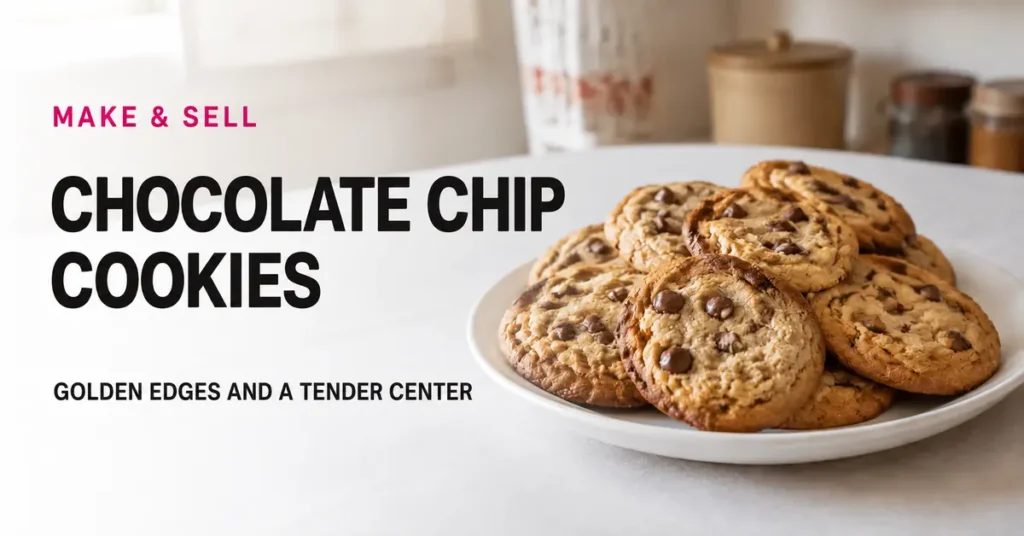
Brown sugar, butter, and plenty of chocolate give these cookies soft centers and golden edges. The original recipe chills the portioned dough before baking. A single test cookie is an easy way to check spread before committing the whole tray.
- Prep
- 15 minutes
- Cook or chill
- at least 30 minutes chilling, then 11–15 minutes baking
- Yield
- about 16–17 cookies at 60 g each
Ingredients
The original recipe uses a 240 ml cup and 15 ml tablespoon. U.S. volumes, pan sizes, and oven settings are rounded; listed grams and milliliters are the best guide for repeating a batch. Use Brazilian table cream and 50% cocoa chocolate powder where specified, rather than assuming U.S. heavy cream or unsweetened cocoa is identical.
Cookie dough
- 180 g softened butter, not melted
- 150 g brown sugar
- 80 g granulated sugar
- 1 large egg
- 1 teaspoon vanilla extract
- 280 g all-purpose flour
- ½ teaspoon baking soda
- ½ teaspoon salt
- 250 g semisweet chocolate chips or chopped chocolate
How to make it
- Line baking sheets with parchment and make room in the refrigerator. Mix butter and sugars until creamy, without whipping in excessive air.
- Mix in the egg and vanilla.
- Add flour, baking soda, and salt; mix only until no dry patches remain.
- Fold in most of the chocolate. Weigh portions of about 60 g, shape into balls, and press the reserved chips on top. Actual count depends on the dough weight.
- Refrigerate for at least 30 minutes. Near baking time, preheat to 350°F (180°C).
- Arrange well apart and bake for 11–15 minutes, until golden at the edges and the centers are set rather than raw.
- Cool for 10 minutes on the tray, then move to a rack. Package when completely cool. Do not taste raw dough containing flour and egg.
Small details that help
Warm butter encourages spreading; too much flour makes a taller, drier cookie. Light-colored aluminum trays bake more gently than dark trays. Keep dough cold between batches and bake one trial cookie to confirm spacing and time.
Portioning and packaging
Freeze raw dough balls separately, then pack by batch for household preparation. Test any baking method from frozen and record extra time. Include chocolate usage, parchment, packaging, chilled storage, electricity, losses, and labor in the finished unit cost.
Thinking of selling this in the U.S.?
Check this exact product with your state and local food regulator before taking orders. Home-food permissions depend on the location, recipe, kitchen, and sales channel. Refrigerated dairy, custard, chicken, and meat products must not be assumed eligible for cottage-food sales. Ask about permits, approved facilities, handling, labeling, and delivery restrictions. The FDA food-business overview is a starting point, not approval to sell this recipe.
Calculate costs from your own batch
- Record ingredient quantities and current local costs in U.S. dollars.
- Add packaging, labels, utilities, refrigeration or freezing, waste, and labor.
- Divide the batch cost by the actual number of acceptable finished units.
- Include applicable taxes, overhead, delivery, and payment fees when setting a price.
No selling price, profit margin, sales volume, or income is guaranteed. A trial batch helps you assess consistency; it does not validate commercial food safety.
Labels and allergens
Check ingredient and packaging labels for milk, eggs, wheat, soy, nuts, and other allergens that apply to this batch. Keep supplier information and ingredient subcomponents, and prevent cross-contact. A short list of likely allergens is not a complete sales label. Ask the regulator what ingredient order, net quantity, business identification, allergen statements, and any cottage-food notice are required. See the FDA food-allergen guidance.
Storage and delivery
Frequently asked questions
Can I use chopped chocolate instead of chips?
Yes, as in the original formula. Chopped bars melt differently and make less uniform pockets.
Is the yield exactly 16?
The ingredient weights can make a little more than 16 portions at 60 g. Weigh the finished dough and record the actual count.
Why do the cookies spread too much?
Butter or dough may be too warm. Chill the portions, check flour weight, and bake a test cookie.