

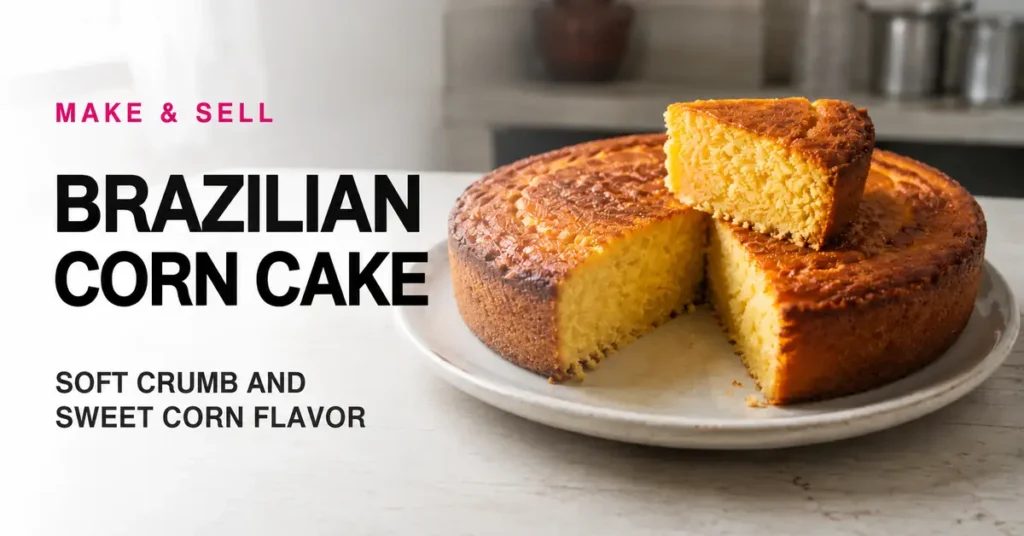
Sweet corn and fine cornmeal make this Brazilian cake soft, golden, and gently grainy. It is different from a savory American cornbread. The original version keeps the batter, pan, and cooling time consistent so the finished cake is easy to slice and package.
- Prep
- 15 minutes
- Cook or chill
- 40–50 minutes baking, plus cooling
- Yield
- one 9-inch cake; about 10 slices
Ingredients
The original recipe uses a 240 ml cup and 15 ml tablespoon. U.S. volumes, pan sizes, and oven settings are rounded; listed grams and milliliters are the best guide for repeating a batch. Use Brazilian table cream and 50% cocoa chocolate powder where specified, rather than assuming U.S. heavy cream or unsweetened cocoa is identical.
Cake
- 170 g drained canned sweet corn
- 3 eggs
- 1 cup milk (240 ml)
- ½ cup neutral oil (120 ml)
- 200 g granulated sugar
- 180 g finely ground cornmeal
- 50 g shredded coconut, optional
- 15 g baking powder
- Pinch of salt
- Butter and cornmeal for the pan
How to make it
- Preheat to 350°F (180°C). Grease a 22 cm (about 9-inch) cake pan and dust with cornmeal. Drain the corn thoroughly.
- Blend corn, eggs, milk, oil, and sugar for about 2 minutes, until the kernels are well broken down.
- Transfer to a bowl and fold in cornmeal, salt, and optional coconut.
- Rest for 5 minutes to let the cornmeal absorb moisture, then gently fold in baking powder.
- Spread in the pan and bake for 40–50 minutes, until golden and set. A toothpick may have moist crumbs but should have no liquid batter.
- Cool on a rack before unmolding, weighing, and packaging. Do not close the package around a warm cake.
Small details that help
Fine cornmeal gives a softer crumb than coarse polenta. Blending after adding the baking powder or starting in a cool oven can leave a heavy cake. Coconut changes both texture and cost; any cheese or fruit filling would require separate storage guidance.
Portioning and packaging
Use the same pan each time and weigh the batter before baking. A food-safe cake box should protect the top without pressing it. Record the finished weight and any rejected slices rather than pricing only from the theoretical recipe yield.
Thinking of selling this in the U.S.?
Check this exact product with your state and local food regulator before taking orders. Home-food permissions depend on the location, recipe, kitchen, and sales channel. Refrigerated dairy, custard, chicken, and meat products must not be assumed eligible for cottage-food sales. Ask about permits, approved facilities, handling, labeling, and delivery restrictions. The FDA food-business overview is a starting point, not approval to sell this recipe.
Calculate costs from your own batch
- Record ingredient quantities and current local costs in U.S. dollars.
- Add packaging, labels, utilities, refrigeration or freezing, waste, and labor.
- Divide the batch cost by the actual number of acceptable finished units.
- Include applicable taxes, overhead, delivery, and payment fees when setting a price.
No selling price, profit margin, sales volume, or income is guaranteed. A trial batch helps you assess consistency; it does not validate commercial food safety.
Labels and allergens
Check ingredient and packaging labels for milk, eggs, wheat, soy, nuts, and other allergens that apply to this batch. Keep supplier information and ingredient subcomponents, and prevent cross-contact. A short list of likely allergens is not a complete sales label. Ask the regulator what ingredient order, net quantity, business identification, allergen statements, and any cottage-food notice are required. See the FDA food-allergen guidance.
Storage and delivery
Frequently asked questions
Is this American cornbread?
It is a sweet Brazilian-style cake with whole corn blended into the batter, not a savory cornbread formula.
Can I use coarse cornmeal?
It gives a rougher texture and different moisture absorption. Fine cornmeal is closer to the original.
Is it gluten-free?
The formula has no wheat flour, but that alone does not establish gluten-free handling or labeling. Check all ingredients and cross-contact controls.