
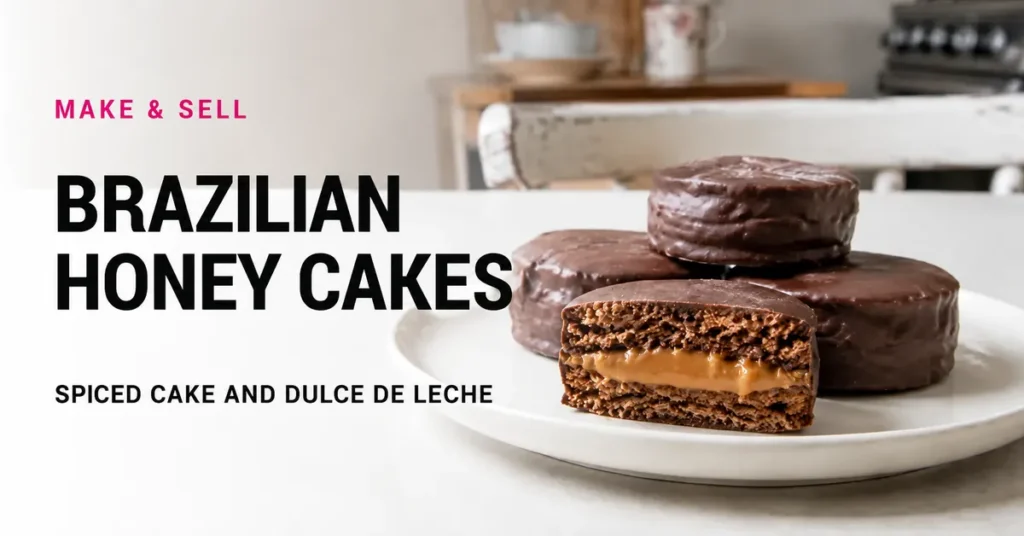
Pão de mel pairs a spiced honey cake with dulce de leche and a thin chocolate coating. Cinnamon and cloves give it a cozy aroma without a complicated finish. Cool the cake completely before filling so the layers stay where you put them.
- Prep
- 25 minutes
- Cook or chill
- 25–30 minutes baking, plus cooling and chocolate setting
- Yield
- about 16 pieces
Ingredients
The original recipe uses a 240 ml cup and 15 ml tablespoon. U.S. volumes, pan sizes, and oven settings are rounded; listed grams and milliliters are the best guide for repeating a batch. Use Brazilian table cream and 50% cocoa chocolate powder where specified, rather than assuming U.S. heavy cream or unsweetened cocoa is identical.
Honey cake
- 300 g all-purpose flour
- 160 g brown sugar
- 40 g Brazilian 50% cocoa chocolate powder
- 250 ml lukewarm milk
- 120 g honey
- 60 g melted butter
- 1 teaspoon ground cinnamon
- ½ teaspoon ground cloves
- 1 teaspoon baking soda
- 1 teaspoon baking powder
- Pinch of salt
Filling and coating
- 400 g thick dulce de leche
- 500 g chocolate or coating suitable for dipping
How to make it
- Preheat to 350°F (180°C). Line a 20 × 30 cm (about 8 × 12-inch) pan, or use evenly sized small cake molds.
- Sift and combine flour, sugar, chocolate powder, spices, baking soda, baking powder, and salt.
- Add milk, honey, and melted butter. Stir only until evenly combined.
- Spread in the pan and bake for 25–30 minutes, until set and a toothpick shows no raw batter. Cool completely on a rack.
- Cut into 16 pieces and split each horizontally. Divide the dulce de leche evenly, stopping short of the edge.
- Melt and temper the coating chocolate as directed, or prepare a suitable no-temper dipping coating according to its label.
- Dip each filled cake, let excess coating drain, and allow to set before wrapping. Keep finished cakes covered and refrigerated because of the filling.
Small details that help
Freshly ground spices can be more intense, so keep the brand and dose consistent. Too much baking soda leaves an unpleasant aftertaste. Chocolate that flows properly creates a thin layer; a very thick coating makes dipping harder and increases cost.
Portioning and packaging
Record cake height, trimmed losses, filling weight, and coating consumption. Plain cake and filled coated cake do not share the same storage assumptions. Use a label that covers the complete product, including the coating and dulce de leche.
Thinking of selling this in the U.S.?
Check this exact product with your state and local food regulator before taking orders. Home-food permissions depend on the location, recipe, kitchen, and sales channel. Refrigerated dairy, custard, chicken, and meat products must not be assumed eligible for cottage-food sales. Ask about permits, approved facilities, handling, labeling, and delivery restrictions. The FDA food-business overview is a starting point, not approval to sell this recipe.
Calculate costs from your own batch
- Record ingredient quantities and current local costs in U.S. dollars.
- Add packaging, labels, utilities, refrigeration or freezing, waste, and labor.
- Divide the batch cost by the actual number of acceptable finished units.
- Include applicable taxes, overhead, delivery, and payment fees when setting a price.
No selling price, profit margin, sales volume, or income is guaranteed. A trial batch helps you assess consistency; it does not validate commercial food safety.
Labels and allergens
Check ingredient and packaging labels for milk, eggs, wheat, soy, nuts, and other allergens that apply to this batch. Keep supplier information and ingredient subcomponents, and prevent cross-contact. A short list of likely allergens is not a complete sales label. Ask the regulator what ingredient order, net quantity, business identification, allergen statements, and any cottage-food notice are required. See the FDA food-allergen guidance.
Storage and delivery
Frequently asked questions
Can I use small molds?
Yes, but size changes baking time and yield. Test a small batch and portion the batter evenly.
Why does the filling squeeze out?
The cake may be warm, the filling too loose, or the layer too thick. Use cooled cake and firm dulce de leche.
Does the coating keep it shelf-stable?
No such claim is made. Confirm the finished filled product’s storage requirements before commercial sale.