

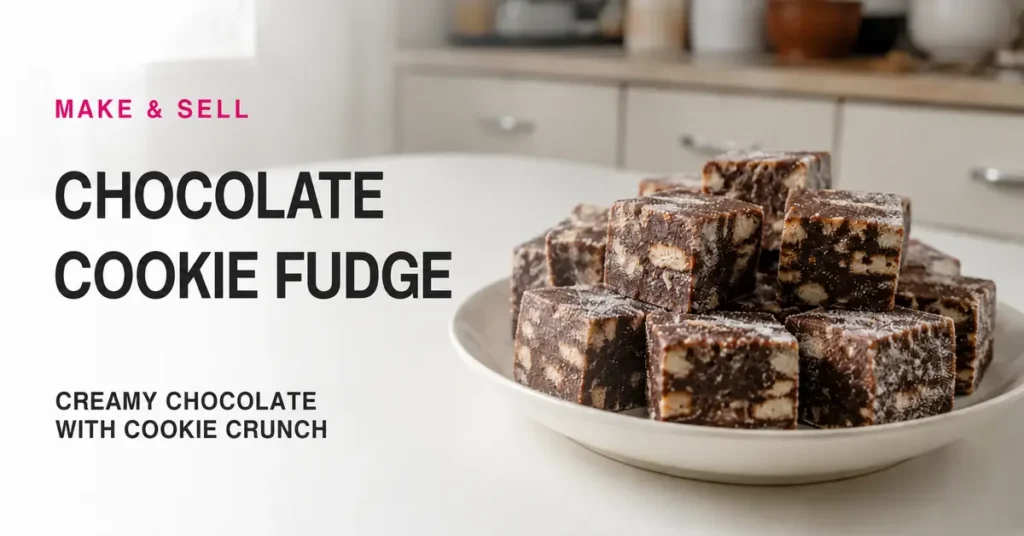
Palha italiana combines soft brigadeiro with crisp cookie pieces. Despite the name, it is a familiar Brazilian sweet. The original recipe keeps the cookies in small chunks so every square has some crunch without becoming difficult to slice.
- Prep
- 15 minutes
- Cook or chill
- about 20 minutes cooking, plus 1–2 hours chilling
- Yield
- about 20 squares
Ingredients
The original recipe uses a 240 ml cup and 15 ml tablespoon. U.S. volumes, pan sizes, and oven settings are rounded; listed grams and milliliters are the best guide for repeating a batch. Use Brazilian table cream and 50% cocoa chocolate powder where specified, rather than assuming U.S. heavy cream or unsweetened cocoa is identical.
Fudge
- 395 g sweetened condensed milk
- 100 g Brazilian table cream
- 80 g semisweet chocolate
- 20 g Brazilian 50% cocoa chocolate powder
- 10 g butter
- 160 g Brazilian cornstarch cookies, broken into ½–¾-inch pieces
Finishing
- Granulated sugar, cocoa powder, or milk powder for coating
- Parchment and food-safe wrappers
How to make it
- Line an 18–20 cm (about 7–8-inch) square pan with parchment. Break the cookies by hand so they retain pieces rather than becoming crumbs.
- Cook the condensed milk, cream, chocolate, chocolate powder, and butter over low heat, stirring the bottom and sides.
- Stop when the cream partly releases from the pan and falls from the spatula in a thick ribbon, slightly softer than a rolling brigadeiro.
- Fold in the cookie pieces just until distributed. Spread in the lined pan and level gently with a second sheet of parchment, without crushing the cookies.
- Refrigerate promptly. Chill for 1–2 hours, until firm enough to cut.
- Mark equal squares, cut with a clean knife, coat lightly with the chosen finish, and weigh before wrapping. Keep covered and refrigerated.
Small details that help
A clean knife, wiped between cuts, stops cookie crumbs from dragging through the filling. Brazilian cornstarch cookies are not cornstarch powder; plain tea biscuits are a possible trial substitution, with a different flavor and texture. Cocoa or milk powder coatings also change the flavor and allergen information.
Portioning and packaging
Measure total finished weight, actual count, and average piece weight. Include coating, parchment, wrapper, labels, and broken cookies in the batch cost. Packaging should protect the pieces and close properly rather than merely look decorative.
Thinking of selling this in the U.S.?
Check this exact product with your state and local food regulator before taking orders. Home-food permissions depend on the location, recipe, kitchen, and sales channel. Refrigerated dairy, custard, chicken, and meat products must not be assumed eligible for cottage-food sales. Ask about permits, approved facilities, handling, labeling, and delivery restrictions. The FDA food-business overview is a starting point, not approval to sell this recipe.
Calculate costs from your own batch
- Record ingredient quantities and current local costs in U.S. dollars.
- Add packaging, labels, utilities, refrigeration or freezing, waste, and labor.
- Divide the batch cost by the actual number of acceptable finished units.
- Include applicable taxes, overhead, delivery, and payment fees when setting a price.
No selling price, profit margin, sales volume, or income is guaranteed. A trial batch helps you assess consistency; it does not validate commercial food safety.
Labels and allergens
Check ingredient and packaging labels for milk, eggs, wheat, soy, nuts, and other allergens that apply to this batch. Keep supplier information and ingredient subcomponents, and prevent cross-contact. A short list of likely allergens is not a complete sales label. Ask the regulator what ingredient order, net quantity, business identification, allergen statements, and any cottage-food notice are required. See the FDA food-allergen guidance.
Storage and delivery
Frequently asked questions
Why are the squares too hard?
The brigadeiro may have cooked too far, or the mixture may be very cold. Cook to a thick ribbon rather than a stiff rolling point.
Can I crush the cookies in a blender?
That creates fine crumbs and loses the contrasting pieces. Break them by hand instead.
Is this shelf-stable candy?
No shelf-stability claim is made for this cream-containing formula. Commercial storage conditions require appropriate validation.